Persistence
Three rescue attempts fail. A fourth succeeds. Return to the work, and change the approach when the conditions demand it.
AN ANTARCTIC ODYSSEY / ERNEST SHACKLETON
The ice took their ship.
It would not take them.
28 men. A vanished ship. An ocean between them and home.
Enter one of history’s extraordinary stories of survival.
01 / SOUTH GEORGIA · DECEMBER 1914
Picture the last harbor falling behind you. Ahead lies Antarctica: a continent Ernest Shackleton intends to cross on foot, from the Weddell Sea to the Ross Sea, by way of the South Pole.
On 5 December 1914, Endurance leaves South Georgia with 28 men aboard. Sailors, scientists, a photographer, a carpenter—and a stowaway. Their wooden ship carries the supplies, boats, and hope for an expedition into the unknown.
They will never begin the crossing.
Rotate the ship. Separate its construction layers.
02 / WEDDELL SEA · JANUARY—OCTOBER 1915
In January, the pack ice locks around the hull. The engines cannot free her. The sea freezes into an unbroken landscape, and Endurance becomes a passenger on the drifting ice.
Days become months. The sun disappears for the polar winter. The crew tends the dogs, records scientific observations, plays games, and keeps to a routine. Frank Hurley photographs a ship suspended in a strange, beautiful prison.
Then the ice begins to press. Timbers groan. The hull bends. Even a ship built for polar waters has a limit.
months held in the ice
before the order to abandon ship
03 / 27 OCTOBER—21 NOVEMBER 1915
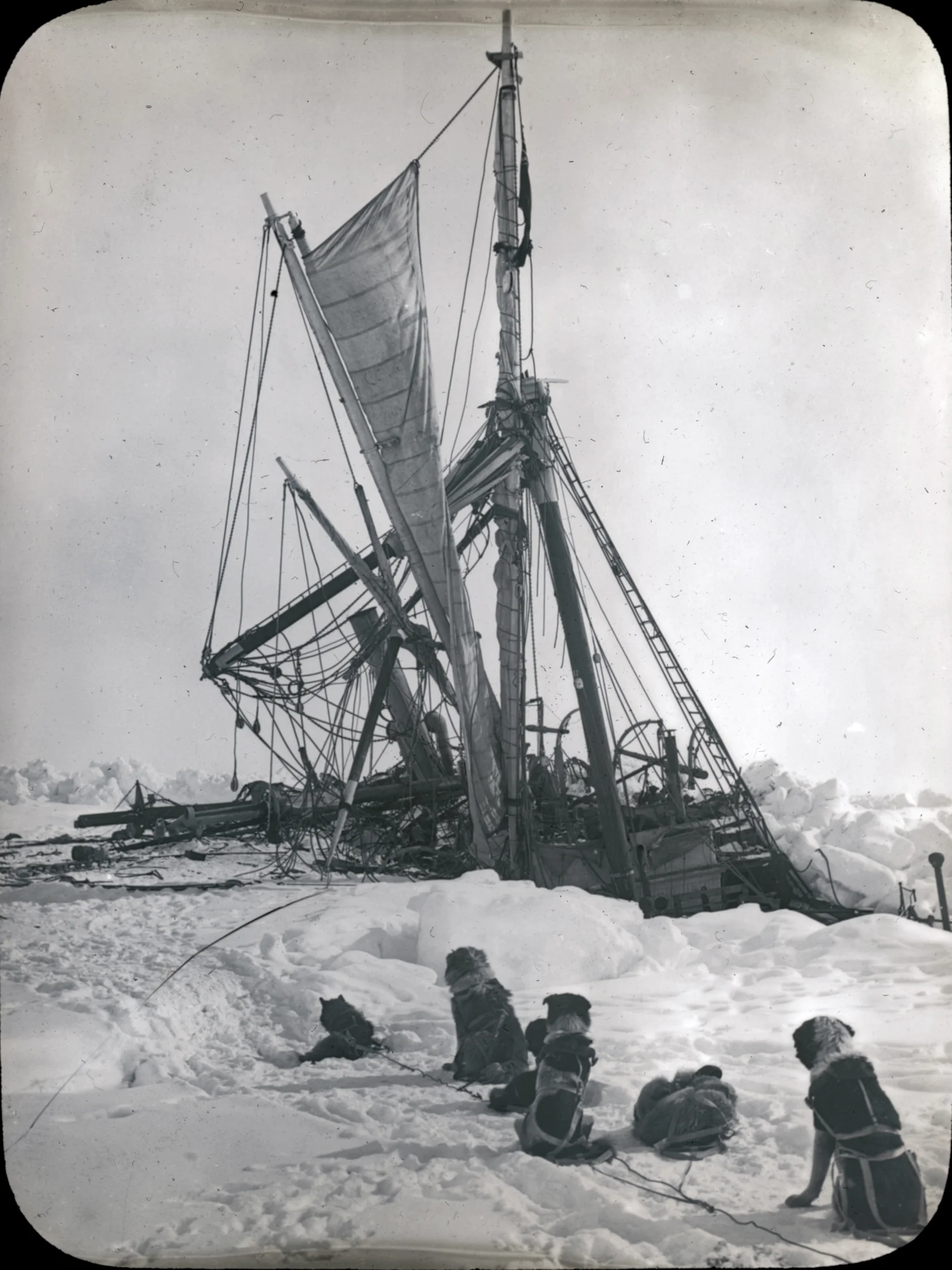
Water is coming in faster than the pumps can remove it. On 27 October, Shackleton orders everyone off the ship. Food, equipment, and the lifeboats come onto the ice.
On 21 November, Endurance sinks. The expedition’s base, transport, and refuge disappear into the Weddell Sea.
Crossing Antarctica no longer matters. The task now is to bring every man home.
No ship. No rescue on the way.
Only one another.
04 / OCEAN CAMP & PATIENCE CAMP · 1915—1916
You cannot simply walk out. Pressure ridges block the way; soft snow swallows the sledges. Dragging heavy boats across this surface exhausts the men for almost no progress.
They camp on a floating slab of ice and let the drift carry them north. Meals, watches, repairs, and the care of equipment give shape to days of cold and uncertainty. The dogs are eventually killed; survival comes at a painful cost.
By April, the floe is breaking up. The ocean that held them captive is now the only way out.
“A man must shape himself to a new mark directly the old one goes to ground.”
— Ernest Shackleton, South
The goal changes. The responsibility remains.
05 / 9—15 APRIL 1916
Three small boats carry all 28 men into a freezing, heaving sea: the James Caird, Dudley Docker, and Stancomb Wills. They row and sail between the ice, soaked by spray, short of sleep and drinking water.
On 15 April, they reach Elephant Island. For the first time in nearly 500 days, there is land beneath their feet. But the island is isolated, outside the usual shipping routes. Waiting for a passing ship offers little hope.
THE BOATS THAT CARRIED THEM
Open each vessel to rotate it and separate its parts.
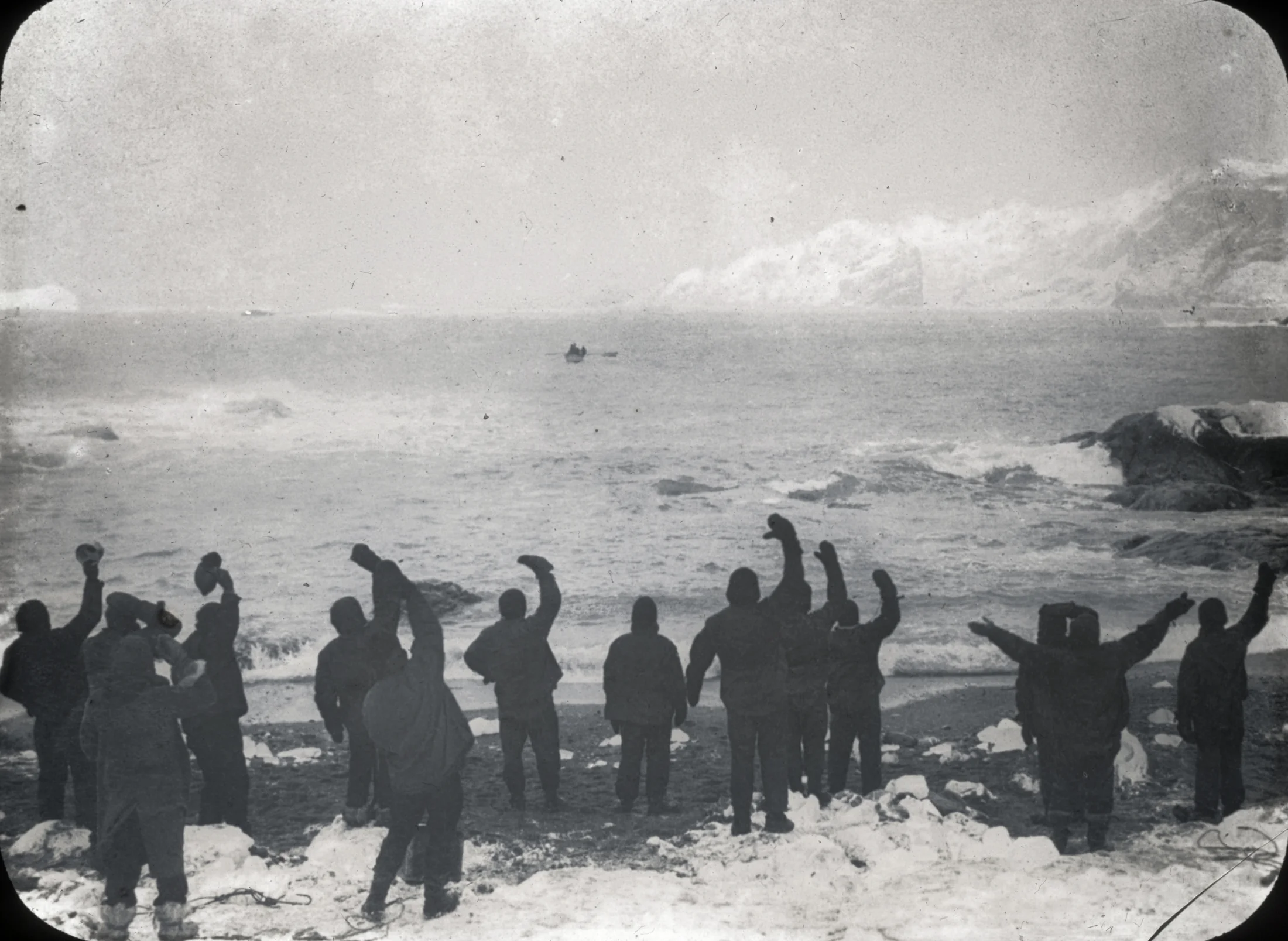 Launching the James Caird, 24 April 1916 · Frank Hurley
06 / 24 APRIL—10 MAY 1916
Shackleton chooses five men to go with him toward South Georgia: Frank Worsley, Tom Crean, Harry McNish, Timothy McCarthy, and John Vincent. Roughly 800 miles of Southern Ocean stand between their tiny boat and help.
McNish raises the sides of the James Caird and builds a makeshift deck of wood and canvas. Ballast steadies the hull. A mast from the Stancomb Wills helps reinforce it.
At sea, Worsley takes brief sun sights when the sky allows. They chip away ice that threatens to capsize the boat, pump out water, and endure watch after watch. A navigational error could send them past the island and into the empty ocean.
RESOURCEFULNESS / OBJECT STUDY
Hurley fashioned a pump from the case of the ship’s compass Flinders bar. Shackleton records that it helped until hairs from their sleeping bags clogged it; they then bailed with a cooking vessel.
A mechanism study based on the written account. Exact internal construction is not documented.
07 / SOUTH GEORGIA · MAY 1916
The James Caird reaches South Georgia on 10 May—on the uninhabited side. The whaling stations lie beyond mountains and glaciers.
Shackleton, Worsley, and Crean set out across the interior, leaving the other three men to recover. With improvised equipment, they cross unfamiliar ice and steep ground in a continuous journey of about 36 hours.
On 20 May, they walk into Stromness whaling station. Help is finally within reach. But 22 men are still waiting on Elephant Island.
Three men walk toward help.
Twenty-two wait for their return.
08 / ELEPHANT ISLAND · 30 AUGUST 1916
Rescue takes more than reaching help. Ice and weather turn back three attempts. On Elephant Island, Frank Wild keeps the party going beneath a shelter made from the two remaining overturned boats.
On the fourth attempt, the Chilean vessel Yelcho, commanded by Luis Pardo, reaches the island with Shackleton aboard. All 22 men are alive. All 28 members of the Endurance party have survived.
This outcome belongs to the Endurance party. The expedition’s separate Ross Sea support party lost three men—a vital part of the larger story.
THE ENDURANCE PARTY
RETURNED ALIVE
09 / WHAT WE CARRY HOME
Their survival depended on skill, leadership, cooperation, help from others, and luck. These are the habits their story invites us to practice.
Three rescue attempts fail. A fourth succeeds. Return to the work, and change the approach when the conditions demand it.
Meals, watches, navigation, and repairs make the next day possible. Keep doing the small things that protect the whole team.
The crossing is abandoned, but the commitment to the crew remains. Know which goal to release and which responsibility to keep.
Survival is collective. Accept help, share the load, and take the next useful step when the finish is still out of sight.
THE STORY DOESN’T END HERE
This is the outline of an extraordinary journey.
The diaries, photographs, and fuller accounts hold much more.
The longer account selected by Nycholas · opens on YouTube
Archival photographs by Frank Hurley, public domain: Endurance in the ice (National Library of Australia); the wreck; James Caird departure (State Library of New South Wales).
3D models are interpretive educational reconstructions, not scans or exact shipwright plans. Major construction groups can be separated; hidden fittings and every original fastener are not represented. The pump’s internals illustrate a possible hand-pump mechanism. Photographic surface materials and studio lighting are from Poly Haven (CC0): Rough Wood, Hessian 230, Rusty Metal 04, and Studio Small 09. These material references add surface realism; they are not samples from the original vessels. Geographic outlines: Natural Earth, public domain. Route lines are simplified historical guides, not a navigational track.


